Wie war dieser Inhalt?
Sprache des Inhalts
Im Moment sind nicht alle Inhalte übersetzt.
- Lernen
- Build AI agents that scale: How startups should choose between Bedrock, Claude Platform, and Direct API
Build AI agents that scale: How startups should choose between Bedrock, Claude Platform, and Direct API

The way startups consume foundation models is changing. Choosing between Amazon Bedrock, Claude Platform on AWS, and the direct Anthropic API is no longer just an API decision, it’s an architectural choice that affects security, scalability, velocity, and operational complexity.
During his re:Invent presentation, “The Dawn of the Renaissance Developer”, Werner Vogels reflected on how AI is reshaping software development and how “tools change, but fundamentals endure”. He compared the evolution of AI to a continual renaissance, where builders must constantly reinvent themselves alongside the technology they use.
Inspired by those reflections, I offer a playful twist on Shakespeare: “To manage or not to manage?”
Specifically, the decision between using Amazon Bedrock as a managed abstraction layer for AI workloads versus integrating directly with Claude APIs. The answer, unsurprisingly, is: it depends. Ultimately, the trade-off comes down to how much undifferentiated heavy lifting your team wants to manage.
Why the Bedrock vs Direct API debate is no longer binary
The launch of Claude Platform on AWS in May 2026 transformed the original binary choice between Anthropic’s Direct API and Amazon Bedrock into a three-option decision matrix. The new platform combines Anthropic’s native Messages API and same-day feature access with AWS billing consolidation, IAM authentication, and CloudTrail audit logging, eliminating the trade-off between cutting-edge capabilities and AWS operational governance, which previously forced startups to pick a side.
Viewed through the AWS Well-Architected Framework, the differences cluster around three pillars:
Operational Excellence: Claude on Amazon Bedrock offers native CloudTrail audit logging, IAM-based authentication, and consolidated AWS billing, while Claude Platform on AWS mirrors the IAM and CloudTrail integration but routes data through Anthropic-operated infrastructure and bills via AWS Marketplace commit-and-consume units.
Security: Bedrock keeps data within the AWS boundary and layers on Guardrails and Knowledge Bases for content filtering and retrieval, whereas both Claude Platform and the direct Anthropic API process data outside AWS on Anthropic-operated endpoints.
Cost Optimization: all three platforms share identical per-token base pricing, yet they diverge on optimization levers. Bedrock provides Provisioned Throughput with hourly commitments and S3-integrated batch processing at 50% discount. Claude Platform adds same-day access to web search, web fetch, Managed Agents, and MCP connectors. And the direct Anthropic API uniquely offers Fast Mode on Opus 4.6 at 6x pricing for latency-sensitive workloads.
In short, platform choice is less about token cost and more about where your data resides, how you authenticate and audit, and which optimization or agentic features you need from day one.
For startups building agentic applications with MCP connectors, Managed Agents, or code execution, Claude Platform on AWS delivers advantages over Bedrock’s integration lag without requiring a separate vendor relationship.
The practical recommendation for AWS-native startups is straightforward: default to Claude Platform on AWS. Use Bedrock when regulatory requirements, AWS-operated data boundaries, or multi-model orchestration become critical. Reserve the direct Anthropic API for teams operating outside the AWS ecosystem.
As AI applications evolve into multi-agent systems with shared memory and orchestration layers, the key differentiator shifts from pricing to platform flexibility.
Why a third option changes everything
The landscape for deploying Claude in production has fundamentally shifted. With enterprise AI spending projected to reach $2.5 trillion by 2026 and Anthropic commanding approximately 32% market share in enterprise AI, the decision of how to access Claude models is no longer a simple binary choice. The launch creates a third deployment path that combines both worlds: same-day access to Anthropic's cutting-edge features with the billing, authentication, and governance infrastructure startups already use on AWS.
The original question, "To manage or not to manage?", now has a nuanced third answer. Whether you prioritize compliance-grade data boundaries, bleeding-edge feature access, or operational simplicity, there is now a deployment path optimized for your specific constraints. Getting this architectural decision right can mean the difference between shipping weeks ahead of competitors and spending valuable engineering time managing infrastructure that does not differentiate your product.
Who operates the inference stack?
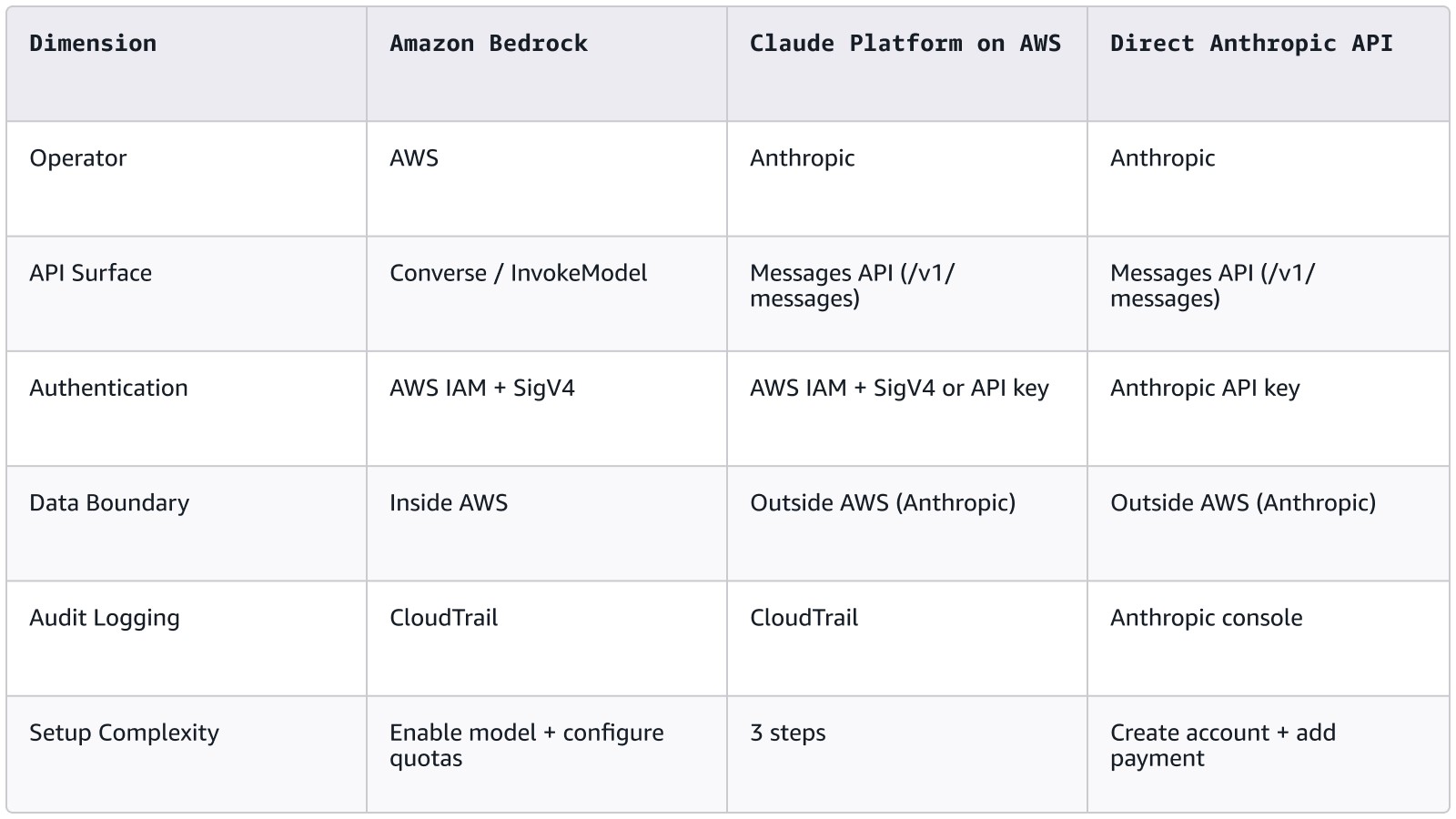
The most fundamental architectural distinction across the three Claude deployment options is who operates the inference stack and where your data lives. Amazon Bedrock is operated entirely by AWS, with data processed inside the AWS security boundary. Claude Platform on AWS is operated by Anthropic, with data processed outside the AWS security boundary. The direct Anthropic API is also operated by Anthropic with data outside AWS, but without an AWS integration layer.
This operator distinction has cascading implications. When AWS operates the stack (Bedrock), you inherit its full compliance certification portfolio, including SOC 1/2/3, HIPAA eligibility, FedRAMP High, and ISO 27001, as native properties of the service. When Anthropic operates the stack (Claude Platform on AWS or Direct API), you rely on Anthropic's own SOC 2 Type II certification, though Claude Platform on AWS adds CloudTrail audit logging so you can monitor and investigate AI usage the same way you do for any other AWS service.
What changes at the API layer?
The authentication differs significantly between the platforms. Claude Platform on AWS uses Anthropic's native Messages API at the /v1/messages endpoint, which is the same API surface as the direct Anthropic API. Amazon Bedrock uses its own Converse and InvokeModel APIs, which wrap Claude's capabilities in AWS's standardized interface. For teams already building against Anthropic's API documentation, Claude Platform on AWS requires zero code changes, you simply redirect your endpoint and swap authentication. Authentication on both AWS-integrated options (Bedrock and Claude Platform on AWS) supports AWS IAM with SigV4 signing. Claude Platform on AWS additionally supports standard API keys for flexibility. Bedrock supports IAM/SigV4 or bearer tokens limited to C#, Go, and Java SDKs. The direct Anthropic API uses only Anthropic API keys with no IAM integration.
Implementation: Three steps to first API call
For startups already running on AWS, Claude Platform on AWS offers a streamlined onboarding. After account activation, getting to your first API call takes three steps:
- Create a workspace
- Authenticate via IAM
- Call the API
There is no need to establish new vendor relationships, negotiate separate contracts, or configure additional billing accounts. This contrasts with the direct Anthropic API, which requires setting up a separate Anthropic account and billing relationship, and with Bedrock, which requires enabling model access through the Bedrock console and potentially requesting quota increases.
The code implementation for Claude Platform on AWS is identical to the direct Anthropic API, with the same Messages API endpoint structure, the same request/response format, and the same SDK methods. The only difference is the authentication header (SigV4 instead of API key) and the endpoint URL. For Bedrock, developers must adapt to the Converse API format or use the InvokeModel wrapper, which introduces a translation layer between Anthropic's native capabilities and AWS's standardized interface.
How do the options compare?
Per-Token Pricing Parity
One of the most important findings for cost-conscious startups is that per-token pricing is identical across all three platforms. Whether you call Claude through Bedrock, Claude Platform on AWS, or the direct Anthropic API, you pay the same rates:
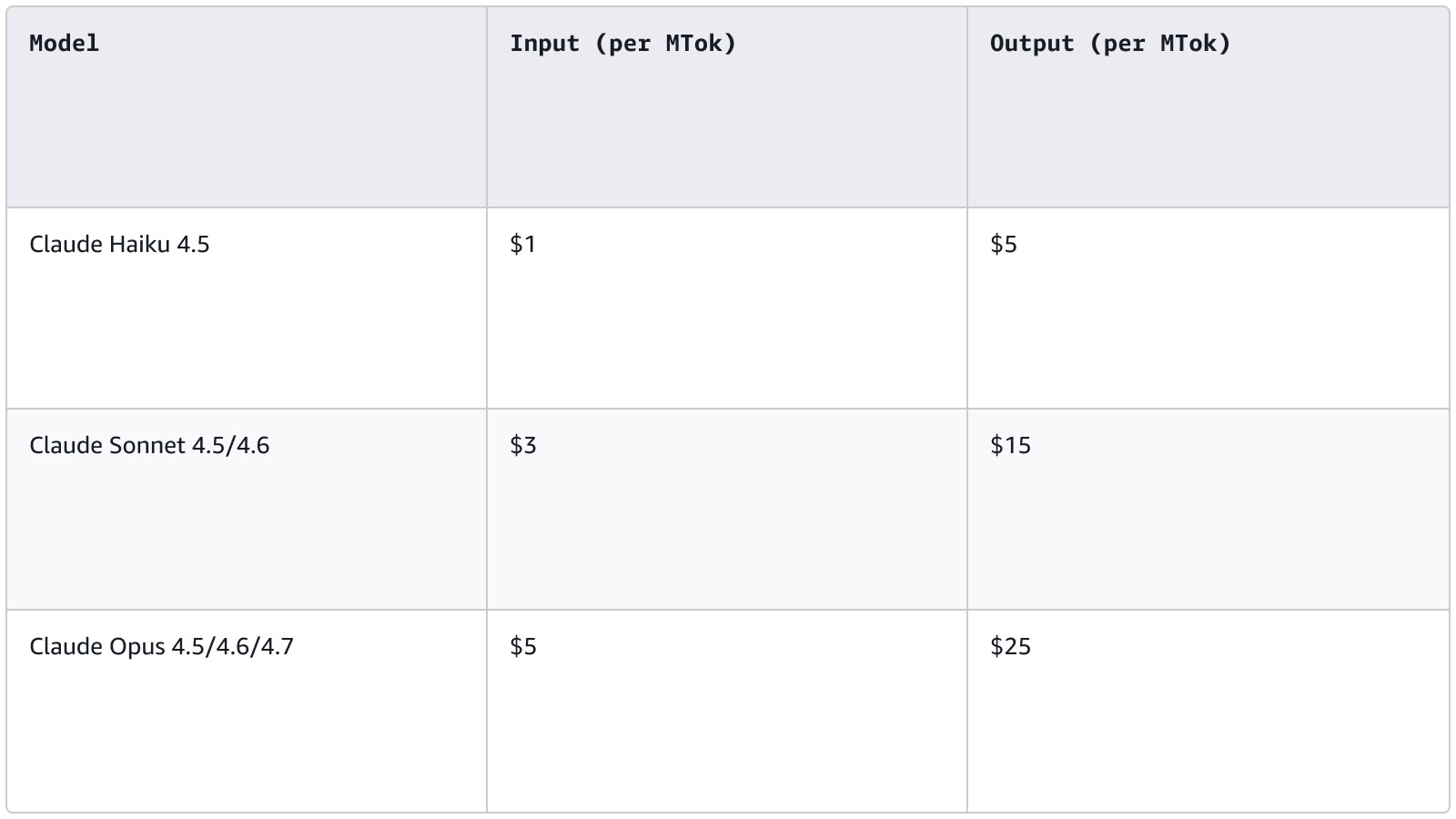
The real cost differences emerge from billing mechanics and optimization features. Claude Platform on AWS bills through AWS Marketplace using Claude Consumption Units (CCUs), where token usage is rated in USD at standard per-model rates and then converted to CCUs at $0.01 per CCU. This means your Claude spend retires against existing AWS commitments, eliminating separate vendor contracts and enabling startups to consolidate AI spend with other AWS services. Bedrock bills per-token as standard AWS line items, while the direct API bills through Anthropic's own invoicing system.
Cost optimization controls
Bedrock offers exclusive cost optimization capabilities not available on the other platforms. Provisioned Throughput provides guaranteed capacity with hourly commitments, and the Reserved Tier, available for Claude Opus 4.5 and Haiku 4.5 since January 2026, offers committed throughput pricing. The existing document notes additional optimizations including prompt caching (up to 90% cost reduction), batch inference (50% discount), and intelligent routing (approximately 30% reduction). Regional and multi-region endpoints on Bedrock include a 10% pricing premium over global endpoints for guaranteed data routing.
What happens when your usage starts scaling?
The rate limit systems differ substantially across platforms. The direct Anthropic API implements a 4-tier usage system with automatic advancement based on cumulative spending, from Tier 1 at $5 minimum to Tier 4 at $400 cumulative spend. Claude Platform on AWS assigns organizations to Tier 1 upon subscription, but critically, automatic tier advancement does not apply, and higher limits require contacting an Anthropic account representative. This is an important constraint for startups looking to scale rapidly.
Amazon Bedrock uses a fundamentally different approach with its three-tier service model, introduced in November 2025. Priority Tier delivers up to 25% better output tokens per second latency, Standard Tier provides consistent performance, and Flex Tier offers cost-effective processing for non-urgent workloads . All models on Bedrock share a hard limit of 10,000 RPM per account per Region, with Provisioned Throughput available for workloads requiring guaranteed capacity beyond on-demand limits.
Latency benchmarks
Performance data from the existing analysis shows that Bedrock can deliver superior latency for certain models. Claude 3.5 Haiku achieves 660ms time-to-first-token (TTFT) on Bedrock versus the Anthropic fleet average of 1,131ms. Bedrock's latency-optimized inference delivers approximately 42% TTFT P50 improvement. However, user reports also indicate scenarios where end-to-end request times show 17 seconds via Bedrock versus 11 seconds via the direct API, suggesting that latency advantages vary by workload type and model.
Claude Platform on AWS and the direct API share the same Anthropic-operated inference stack, so their latency profiles should be broadly equivalent. No specific benchmarks comparing Claude Platform on AWS with Bedrock were published in the launch materials.
Where does Bedrock win?
While Claude Platform on AWS and the direct API offer same-day access to Anthropic's latest features, Bedrock differentiates itself through deep AWS-native capabilities that neither alternative can replicate. Bedrock provides Guardrails for content filtering and safety enforcement, Knowledge Bases for managed RAG workflows, and AgentCore for production-grade agent orchestration (GA since October 2025).
Additionally, Bedrock offers access to nearly 100 serverless models across multiple providers, giving teams the flexibility to mix and match models within a unified platform. For startups already invested in the AWS ecosystem, these integrated services eliminate the need to build and maintain separate infrastructure for content moderation, retrieval-augmented generation, and multi-model routing, accelerating time-to-production while maintaining enterprise-grade security and compliance.
So, which deployment model should you choose?
As you evaluate Claude deployment options for your AI applications, security should be your top priority. Whether you choose Amazon Bedrock, Claude Platform on AWS, or the direct Anthropic API, the foundation of any production-ready AI system starts with protecting your data, your customers, and your intellectual property. AWS provides the tools and infrastructure to make security a seamless part of your architecture, rather than an afterthought.
The good news is that you no longer face a binary trade-off between governance and feature velocity. With Bedrock, Claude Platform on AWS, and the direct Anthropic API now offering distinct operational models, teams can choose the platform that best aligns with their compliance requirements, developer workflows, and scaling strategy. Whether you need Bedrock's deep AWS-native integrations, Claude Platform's same-day feature access with simple AWS billing, or the direct API's flexibility, there is a path for you.
The best way to evaluate these trade-offs is through experimentation. Benchmark against your own workloads, test the operational controls that matter to your organization, and optimize for long-term flexibility rather than short-term convenience.
Wie war dieser Inhalt?